
Report on the trip to Ukraine/Hungary in May 2023
by Bob & Elisabeth Hatton
Delivery also included an important drug needed to satisfy blood flow during operations. This very expensive drug had to be transported at a certain temperature, which meant that we had to cool it on the long journey to Eastern Europe. This was a major challenge for us.
We worked with a Hungarian organization that made contact with the hospital and also transported a lot of relief supplies to Ukraine. They also picked us up as companions and brought us to the destination of our aid delivery. Due to the tight schedule the Hungarian partners had, this was only on the 8th and 9th. May is possible. Sunday, the 7th. May, we took the night train from Augsburg to Budapest. The joy was great when we were picked up by Zoltan Agoston, the head of our Hungarian partner organization.
It took us quite a while to pick up another team member who would drive us from Budapest to Ukraine. We arrived at Tiszabeks on the Hungarian-Ukrainian border around 3 p.m. Crossing the border took quite a long time. The departure from Hungary was also quite difficult. Every person was looked at, our passports were carefully checked. Then the customs officers inspected the vehicle in which we traveled. We went 200 meters further and had to go through the same procedure again. This time, however, we had to open our luggage as dogs were sniffing for banned substances that we might have brought with us. In the end, we had spent an hour at the border.
It took another 40 minutes until we reached Mukachevo at night. There was already a family waiting for us, where we could find rest overnight. It was good to take a break after the long and exhausting journey.
The next day we drove to Uschogrod to pick up the equipment. We wanted to visit our friends in the Nehemiah center in the city, to say "hello" for short. Last year, we supported them in their work. They had helped many refugees and even offered several courses. In these courses, they had supported children who were traumatized by bad experiences. These children had lived in basements for weeks while bombs fell on their cities. The center was full of people and everywhere life pulsated. Our stay was shortened because Nehemiah was expecting an important delegation from the UN High Commissioner for Refugees to visit.
Finally, we managed to reach the warehouse where our equipment and medicines were kept. The medications were carefully taken out of the refrigerator and placed in the refrigerator boxes. We checked the other articles and everything was correct and present. But a problem arose: We did not get the things in the intended transporter. The administrator of the camp, Slavik, organized a larger vehicle for us and had everything brought to the hospital in Mukachevo.
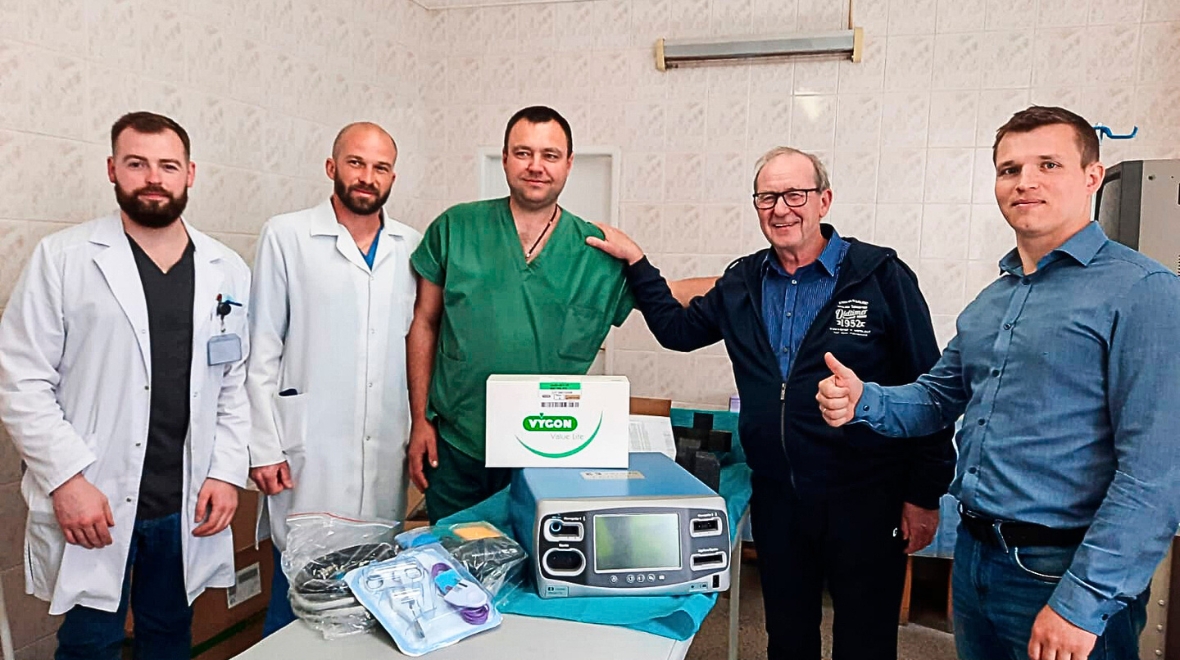
We reached the hospital about the same time as another vehicle from Hungary. They had brought hospital beds, cots and also some wheelchairs. While they were taken out of the van and stored, Dr. came to us. Jevgen Mesko. Dr. Jevgen Mesko is the 37-year-old director of the hospital. The meeting with him was very emotional. We had finally implemented what we had planned for the last 8-9 months. When I told him that we had succeeded in procuring a certain and eagerly awaited device, he climbed into the back of the van and searched the delivery we had brought. In fact, the desired apparatus was in the rear part of the car. As Dr. Jevgen saw it, he immediately called his chief surgeon to bring him the good news. The surgeon was just performing an operation, but still could not hide his joy at the news: "This is impossible," he said.
We handed over all the equipment to the hospital and could feel the excitement and joy in the air! They also explained why: The hospital has ten operating rooms and can perform up to 1000 operations per month. The city, which is supplied by the hospital, is full of refugees who also need medical treatment. Some of these are routine treatments, others would be urgently needed, but not feasible due to capacity shortages. The equipment we brought means an enormous increase in capacity. With the new equipment, they could perform an additional 400 operations per month. And the better surgical methods they can perform mean that patients can be discharged after 2-3 days instead of staying in the hospital for 6-7 days.
The next stage of work in the hospital is to support the establishment of two new wards, one for children and the other for heart patients.
Our gratitude to all donors cannot be expressed in words. Through their generous support, we are able to continue our important work. Your help enables us to improve medical care in the difficult situation in Ukraine. Every donation is valuable and supports us in our work in the hospital and in helping refugees and those in need in this war-torn country.
A big thank you also goes to the Else Kroner Fresenius Foundation, without which we could not have started this great project.
Thank you very much.
Donate to this project →